Analysis · Türkiye · Europe
Eurosatory 2026: A New Stage for Türkiye’s Defence Industry
How Eurosatory 2026 showed Türkiye’s defence industry shifting from exports to production in Europe while still locked out of EU defence programmes.
 31 July 20265 min read
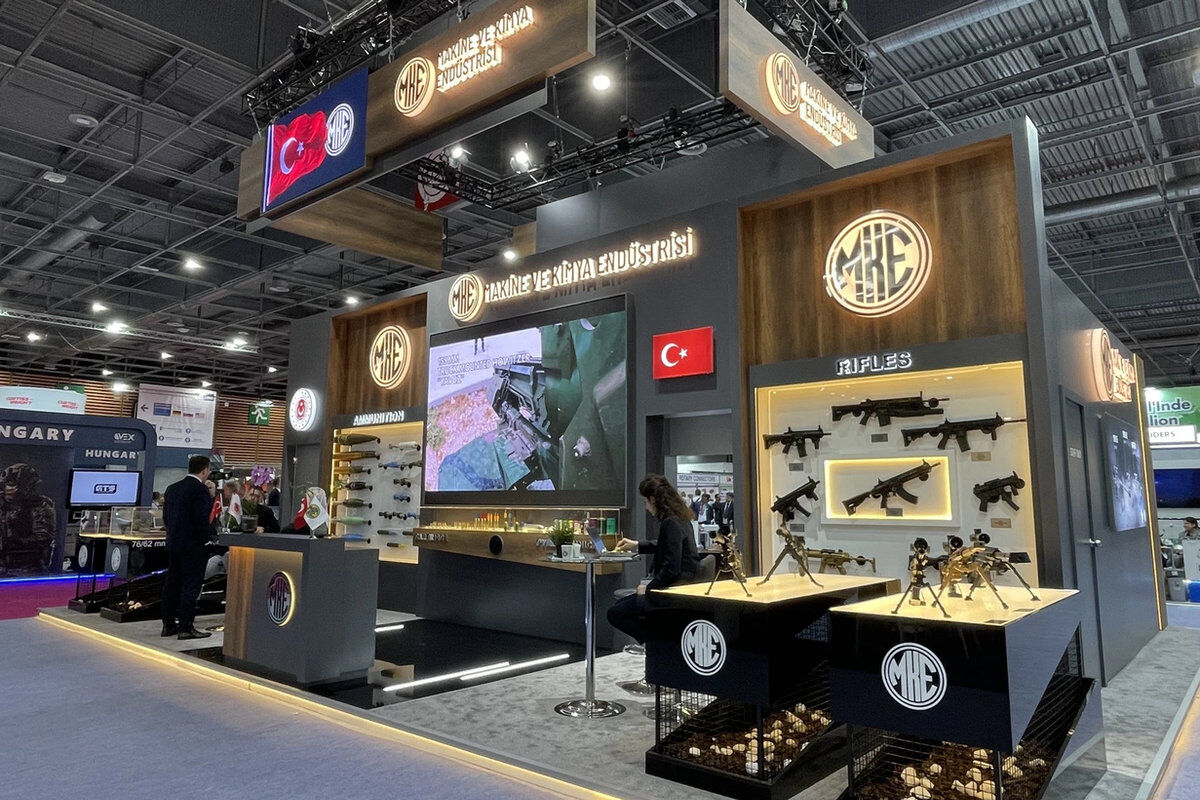
Eurosatory 2026, held in Paris, revealed not only the growing export capacity of Türkiye’s defence industry but also how the country intends to establish itself in the European defence market. Türkiye no longer aims merely to sell weapons to Europe; it aims to manufacture in Europe, build partnerships and become a permanent part of the continent’s defence supply chains.
Held at Paris Nord Villepinte on 15–19 June 2026, Eurosatory was one of the world’s most important gatherings in the field of land and air-land defence systems. This year’s agenda was set by unmanned systems, electronic warfare, artificial intelligence, cyber security, air defence and the production capacity Europe needs as it rearms. The fact that Eurosatory’s organisers placed particular emphasis on the concepts of “multi-domain superiority” and “industrial resilience under war-economy conditions” showed that the exhibition carried a broader strategic meaning than a conventional product show.
Türkiye, for its part, was represented at the exhibition by more than 50 companies. Alongside major manufacturers such as ASELSAN, ROKETSAN, HAVELSAN, the Mechanical and Chemical Industry Corporation (MKE), FNSS and Otokar, smaller firms operating in electronics, communications, mechanical components, vehicle subsystems and advanced manufacturing were also present. This broad participation showed that the Turkish defence industry has moved beyond a limited structure made up of a few large companies and become a multi-actor production ecosystem.
Yet Türkiye’s position at Eurosatory 2026 cannot be explained by the number of participating companies alone. The real issue is the transformation under way in Ankara’s strategy towards the European defence industry market. Turkish companies are no longer simply trying to export systems produced in Türkiye to European countries. Instead, they are turning to acquiring companies in Europe, setting up joint ventures, producing locally and transferring technology.
Türkiye is no longer just a drone country
For a long time, the foreign press assessed the international rise of the Turkish defence industry through unmanned aerial vehicles, above all the Bayraktar TB2. Eurosatory 2026, however, showed that Türkiye’s product range has broadened considerably.
At the heart of ASELSAN’s presentation at the exhibition were electronic warfare, radar and counter-UAV systems. The company exhibited its DRONEDEF system, one of the counter-drone components of Steel Dome, Türkiye’s multi-layered air defence project. The system aims to bring together radar, electro-optical detection, electronic jamming and various interception means within a single integrated architecture.
The importance of this field has become more visible in the light of developments unfolding around the world today. As low-cost unmanned aerial vehicles have strained expensive missile systems and conventional air defence networks, armies have been pushed to develop more economical, multi-layered counter-UAV solutions. Türkiye’s advantage here lies not only in producing drones, but also in developing the systems that detect them, neutralise them electronically or destroy them physically.
ROKETSAN, for its part, stood out with its precision-guided munitions, anti-tank missiles, air defence systems and a family of missiles that can be launched from UAVs. The portfolio the company exhibited at Eurosatory included the MAM series of munitions, the İHA-230, the ÇAKIR cruise missile, the KARAOK and UMTAS anti-tank systems, and the SUNGUR and HİSAR-O air defence solutions. This diversity shows that Türkiye has become a country that not only produces platforms but can also supply the munitions those platforms carry.
HAVELSAN’s presence at the exhibition represented a less visible but increasingly critical side of the Turkish defence industry: software, command and control, and systems integration. The company presented solutions that combine battle management, mission planning, tactical data links, artificial intelligence, simulation and autonomous systems within a single operational architecture.
The picture that emerged at Eurosatory 2026, therefore, is that Türkiye is not merely a country selling armoured vehicles, missiles or drones. Ankara is seeking to offer an integrated defence ecosystem capable of linking the different layers of the battlefield, from sensors to munitions and from electronic warfare to command and control.
From exports to production in Europe
One of the most important developments of the exhibition from Türkiye’s perspective was the Danube Defence Systems partnership that FNSS and the Czech-based CSG Defence plan to establish in Slovakia. The venture aims to produce armoured vehicles based on FNSS technology, above all the KARPAT medium tank, in Europe and to market them to European armies.
For us, this agreement means more than an ordinary export contract. Rather than producing in Türkiye and selling to Europe, the Turkish company is entering a production structure inside Europe. In doing so, it creates local employment, works with European subcontractors, transfers technology and positions itself as part of the European defence industry.
Otokar’s activities in Romania offer a more advanced example of the same transformation. The company signed a contract worth around €857 million covering the supply of 1,059 COBRA II armoured vehicles for the Romanian Ministry of National Defence. While most of the vehicles are to be produced in Romania, Otokar acquired 96.77 per cent of the Romanian company Automecanica for approximately €85 million. The first Romanian-built COBRA II was unveiled in May 2026.
This model shows the fundamental direction of Türkiye’s European strategy: instead of being a supplier selling products into Europe from outside, to become a local actor producing within Europe.
This has a political as well as an economic significance. A Turkish-designed system produced in Europe should not be regarded merely as a “weapon imported from Türkiye”. Because the workers, companies and supply chains of the producing country benefit from the project, the product’s political acceptance may also become easier.
Europe’s need, Türkiye’s opportunity
European countries are rapidly increasing their defence budgets. Total defence spending by European Union member states is reported to have reached €418 billion in 2025 and is expected to rise to around €454 billion in 2026. EU spending on defence equipment procurement also rose by 26 per cent year on year in 2025, to approximately €115 billion.
Yet more money does not automatically mean more military capability. The production lead times, munitions capacity and fragmented supply structure of the European defence industry make it difficult for rising budgets to translate into capabilities on the ground in the short term.
This is precisely where Türkiye comes to the fore. Compared with their competitors, Turkish companies offer systems that are more cost-effective, faster to deliver and adaptable to customers’ requirements. Türkiye’s defence exports have roughly tripled since 2021, reaching the $10 billion mark in 2025. The fact that around $5.6 billion of these exports went to European and United States markets shows that Türkiye is no longer a producer selling only to the countries of the Middle East, Africa or Turkestan (Central Asia). Türkiye’s real advantage lies in its ability to combine a good level of technology with more affordable prices, serial production capacity, short delivery times and local production offers.
Inside NATO, outside European Union defence
This is where the fundamental contradiction emerges for Türkiye. Although Türkiye is one of NATO’s largest military powers and occupies a geographical position of major importance for European security, it remains outside the European Union’s defence industry programmes.
The EU’s Security Action for Europe mechanism, known as SAFE, will provide up to €150 billion in low-cost, long-term loans to support joint defence procurement by member states. But the programme’s “buy European” approach requires that the bulk of a project’s value come from manufacturers in the EU, the European Economic Area or eligible partner countries.
As of July 2026, Türkiye has no security and defence partnership with the EU that would allow it full participation in SAFE. Turkish companies therefore cannot gain direct and full access to the financing and joint procurement projects the programme offers. Objections from Greece and the Greek Cypriot administration to Türkiye’s broader inclusion in the programme also continue.
The result is a paradoxical situation. While European countries increasingly need Turkish defence products and Türkiye’s production capacity, the European Union’s institutional defence mechanisms do not admit Turkish companies to the centre of the system. Yet FNSS’s joint venture in Slovakia and Otokar’s move to production in Romania, Spain’s decision to procure the HÜRJET aircraft, the joint venture set up between Baykar and Italy’s Leonardo, and Baykar’s agreement with France’s Safran Electronics & Defense are all seen as pragmatic steps to get around this obstacle. In other words, when Turkish companies cannot access EU programmes as Türkiye-based manufacturers, they try to embed themselves indirectly in the European defence ecosystem by incorporating in Europe (Slovakia and Romania) and producing locally.
Conclusion: where does Türkiye stand?
Eurosatory 2026 proved that Türkiye is in the top tier of the defence industry. The exhibition also displayed Türkiye’s strengths: a broad product range, cost, serial production capacity, short delivery times and partnerships based on technology transfer.
But here lies a fundamental contradiction. While Türkiye sits at the centre of European security through NATO, it is not inside the system when it comes to the European Union’s defence financing and joint procurement mechanisms. Turkish companies are therefore trying to strengthen their position in the European market not only through exports, but through local production in Romania and Slovakia, joint ventures in Italy and technological cooperation with France and Spain.
In the period ahead, Türkiye’s success will not be determined solely by the number of missiles, radars or armoured vehicles it sells. What will really matter is the extent to which Turkish companies can embed themselves in Europe’s production chains, and whether they can turn temporary commercial agreements into lasting industrial partnerships.
In this respect, Türkiye is neither fully inside nor fully outside European defence: it is an actor that sits institutionally on the periphery of the system while moving, industrially, ever closer to its centre.