Analysis · G7
G7 Évian 2026: The West’s New Renaissance?
An analysis of the G7 Évian 2026 summit — Ukraine, Iran, China, critical minerals, AI — and what it says about the West’s place in a multipolar world.
 7 July 20267 min read
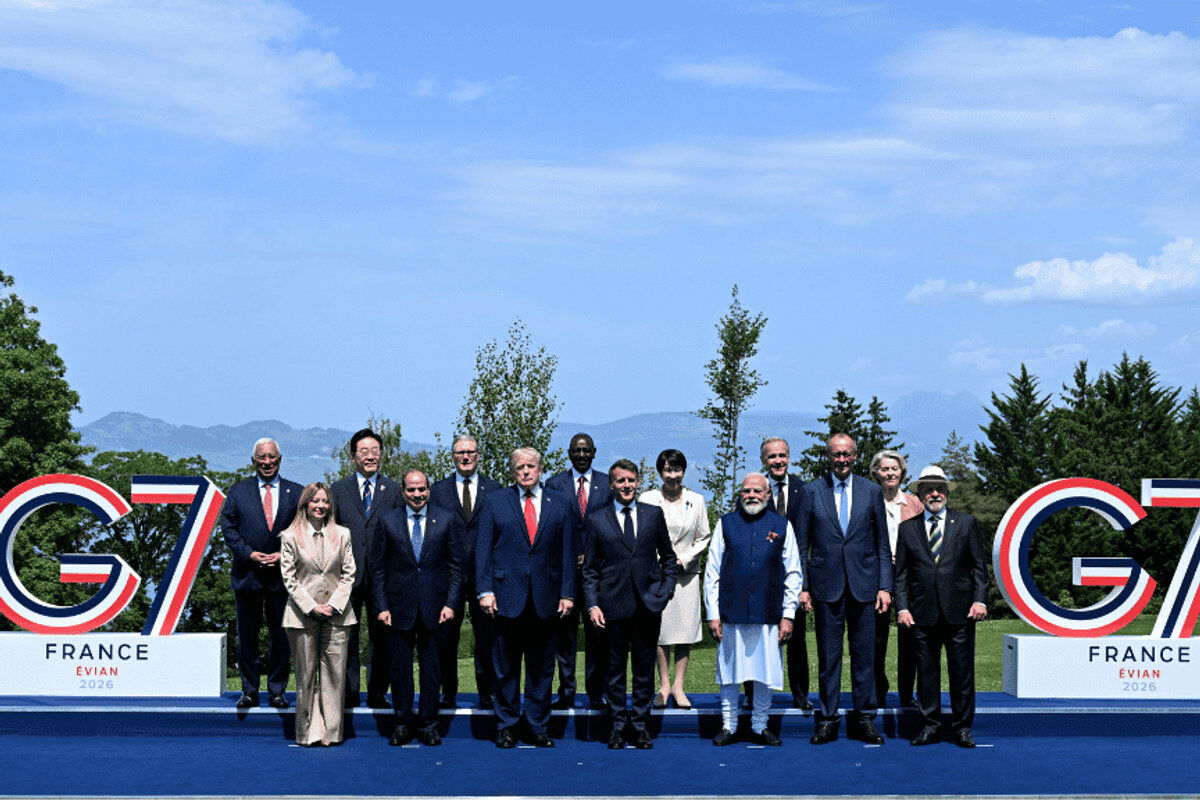
The G7 summit was held in Évian-les-Bains, France, on 15–17 June 2026. Beyond the permanent members, emerging states such as India, the United Arab Emirates, Kenya, Brazil, South Korea, Egypt and Qatar also took part. In the current international climate, the summit took place at a critical juncture, as the global balance of power is being reshaped. The Russia–Ukraine war, the tensions surrounding Iran and the Strait of Hormuz, economic rivalry with China, the struggle over critical minerals, the rise of artificial intelligence and the question of migration were among the main issues discussed at the summit.
The choice of Évian carried a symbolic meaning, for the same town had hosted the G8 summit in 2003. At the time, Russia was still part of the summit. The Western world, though divided internally over the Iraq War, still held the monopoly of power within the global order. By 2026, the same Évian had become the mirror of a very different world. Russia has ceased to be part of the summit and, through the war in Ukraine, has turned into one of the principal forces ranged against the G7. China stands at the centre of economic and technological competition. Middle powers are acting more independently. Évian 2026 can therefore be thought of as a summit that symbolically marks the passage from the globalisation dream of 2003 to an age of multipolar crises.
The Changing Role of the G7
I think it is essential to say a word about the G7 and the purposes for which it was founded. The G7 is a consultative platform made up of the United States, Canada, the United Kingdom, France, Germany, Italy and Japan. The European Union also takes part in the summits in an institutional capacity. It was founded on 15 November 1975 in Rambouillet, France, with the aim of creating a common ground for coordination among economically and industrially advanced countries in the face of economic crises and global imbalances. Évian 2026, however, showed that this platform is no longer merely a table at which economics is discussed. Issues such as the war in Ukraine, Iran and the Strait of Hormuz, dependence on China, critical minerals, artificial intelligence and migration revealed that the G7 is increasingly turning into a broader geopolitical crisis table.
This transformation is in fact directly linked to the structure of today’s international system. Economics, security, technology and energy are no longer separate domains. A country’s industrial capacity, supply chains, artificial intelligence infrastructure, access to energy resources and military resilience have become parts of a single strategic equation. Évian 2026 can therefore be read not merely as the West’s attempt to respond to current crises, but also as an effort to redefine its own position in the new world order.
The Two Main Axes of the Security Agenda: Ukraine and Iran
One of the most important items at Évian 2026 was the Russia–Ukraine war. The G7 countries once again underlined their support for Ukraine’s sovereignty and territorial integrity. Official statements highlighted air defence, additional defence systems, long-range capabilities and support for Ukraine’s military production capacity.
This was not merely a message of support for Ukraine. It was also an effort to show that the Western alliance against Russia still stands as a united structure. In recent years in particular, certain negative social and political signals had emerged within the West on the question of Ukraine. The prolongation of the war, its economic costs and domestic political pressures had made Ukraine policy more contentious in both Europe and America. Despite this, the decisions taken at Évian showed that the West has no wish to step back in the face of Russia.
According to The Guardian, Emmanuel Macron stated after the summit that a renewed “synchronisation” had been achieved within the G7 on Ukraine. In fact, this remark showed that the West was trying not merely to issue joint statements, but to rebuild cohesion within its own ranks.
The summit’s other major security item was Iran and the Strait of Hormuz. Hormuz is one of the most critical chokepoints in world energy trade. A crisis there would therefore affect not only the region: from oil prices to supply chains, it would have a far wider impact and could trigger crises on a global scale.
The G7 statements stressed that free passage through the Strait of Hormuz is fundamental to global trade. Under the leadership of France and the United Kingdom, there was talk of an independent multinational defence initiative that could facilitate commercial maritime traffic in the region. This picture shows that the G7’s security agenda is taking shape according to the same logic in two different geographies. The West’s security architecture is being reshaped around Russia in Europe and around Iran in the Middle East.
China, Critical Minerals and the Reduction of Dependencies
Another striking aspect of the summit is that economics and security are now placed in the same category. For the G7 countries, trade, investment, technology, energy and industrial policy are no longer purely economic matters; they have become questions of national security in their own right.
In this context, China was one of the most important factors in the background of the summit. Even though not every item at the summit mentioned China by name, expressions such as trade imbalances, non-market practices, market size, supply-chain dependencies and vulnerabilities in critical sectors pointed largely to a China-centred global economic structure. The official statements on economic growth placed particular emphasis on the stability of energy markets, the diversification of supply chains and the reduction of dependencies in strategic sectors.
The question of critical minerals has a particular importance within this framework. Lithium, cobalt, nickel, rare earth elements and similar resources have become essential inputs for many fields, from electric vehicles to the defence industry and from artificial intelligence infrastructure to the energy transition. The G7’s statement on critical minerals drew attention to the strategic role of these resources for the digital and energy sectors. The same text stated that supply chains must be diversified in the face of market concentration, dependencies and export restrictions.
This in fact reveals the fundamental dilemma of Western states in relation to China. The West wants to preserve its technological superiority, yet a significant share of the raw materials and intermediate products needed to produce that technology depends on supply chains that China controls or in which it holds a strong position. That is why, at Évian 2026, the economy was addressed not as a matter of growth or trade in the classical sense, but as a matter of reducing dependencies in strategic sectors.
Artificial Intelligence, the Digital Sphere and Migration
Another prominent item at the summit was artificial intelligence and digital security. It was striking that Macron stressed the need for legal regulation of this field in order to “prevent advanced artificial intelligence technologies from falling into the hands of authoritarian regimes and to protect cyber security”, because this showed that artificial intelligence is no longer a matter for technology companies alone. Today, artificial intelligence has become a new factor of power that directly affects many fields, from security policy to the financial system and from the labour market to education and public administration.
The emphasis in the G7 texts on the effects of frontier AI technologies on the financial system, productivity, labour markets and cyber security also clearly reflects this transformation. The fact that fields such as quantum technologies, data security and cyber defence are now assessed within the framework of economic security shows that the technology race has become an arena of competition that is not merely economic but also geopolitical.
A similarly security-focused approach was taken to the question of migration. In the fight against migrant smuggling and human trafficking, the G7 countries emphasised dismantling the economic models of criminal networks, cooperating with digital platforms and increasing coordination with countries of origin and transit. This picture shows that in the West, migration is no longer treated solely as a humanitarian issue, but as one intertwined with border security, organised crime and social order.
In short, Évian 2026 laid bare how far the West’s understanding of security has expanded. Security is no longer confined to military threats: algorithms, data flows, social media platforms, border movements and people smuggling have become part of this new security architecture.
Security and the Crisis of Legitimacy
Although Évian 2026 sought to send a message of unity in diplomatic terms, the security atmosphere around the summit revealed another reality. According to Le Monde, some 16,000 security personnel were deployed for the summit. QR-code entry systems, red and blue security zones and extensive checkpoint areas were put in place.
These security measures show that summits such as the G7 are no longer merely diplomatic gatherings, but have also become targets of popular protest. The G7 is seen by many as a symbol of global inequalities, the capitalist order and Western-centred decision-making mechanisms. According to Reuters, around 20,000 people took part in the protests around Évian, and tensions flared at certain points.
The disputes between France and Switzerland over security and cost-sharing revealed yet another dimension of the summit. Although Switzerland was not hosting the summit, it became an important part of the process because of Geneva Airport, border controls and regional security. Le Monde wrote that on the Swiss side, the security trauma created by the 2003 G8 summit is still remembered, and that serious measures were again taken in the border areas in 2026.
This picture clearly exposes the G7’s problem of legitimacy in the eyes of the public. Despite the G7’s considerable economic, diplomatic and military capacity, its decisions no longer command acceptance at the global level. The countries of the Global South, rising regional powers, social movements and alternative institutions are increasingly questioning Western-centred decision-making mechanisms.
Conclusion
At this stage of transition to a multipolar world order, the political fragmentation and crises in which the Western world finds itself have in fact become a trigger for the West to reposition itself within the new order. The support given to Ukraine at the G7 Évian 2026 summit, the emphasis on security through Iran and the Strait of Hormuz, the strategic concerns expressed over critical minerals and supply chains, and the steps taken towards regulating artificial intelligence and the digital sphere can all be assessed in this context.
Yet the same summit also exposed the limits of the G7. It served as confirmation of the fact that the West can no longer shape the world on its own. One of the clearest signs of this is that rising regional actors such as Qatar, Kenya, Egypt, India and Brazil have begun to play key roles in the multipolar world, and that efforts were made to include these countries in the summit as partners.
Moreover, the maturing of alternative structures such as BRICS in the face of Western-centred global institutions, and the Global South’s growing interest in them, is narrowing the West’s room for manoeuvre. Economic and military embargoes that were once applied with relative ease no longer produce the same effect; indeed, in some cases new balances are emerging that force Western states to make concessions.
Évian 2026 should therefore be seen less as a summit of triumph than as a search for adjustment. The Western world wanted to display its power at this summit; but at the same time it was forced to acknowledge that it now lives in a world that is more complex, more fragmented and richer in alternatives.
China’s economic weight, Russia’s military challenge, Iran’s regional influence, the growing autonomy of middle powers and the Global South’s search for alternatives all show that the Western-centred order no longer functions as smoothly as it once did.
This is where the real question arises. Will the G7 be able to build a more balanced and inclusive relationship with new actors in a multipolar world? Or will it act on the reflex of preserving its own order and deepen the global crisis of legitimacy still further? The true significance of Évian 2026 lies not in providing a definitive answer to this question, but in having made the question unavoidable.
Sources:
Official / Institutional Sources
Élysée. (2026, 17 June). “Les résultats du G7 d’Évian.” Présidence de la République française.
News and Current Sources
Reuters. (2026, 16 June). “Anti-capitalist protests at the G7 summit.” Reuters.
Le Monde. (2026, 14 June). “Heavy security deployed around Evian for G7 summit.” Le Monde.