
Analysis · Türkiye · Egypt
Türkiye–Egypt: A New Era from Crisis to Realpolitik
How the February 2026 Cairo summit turned Türkiye–Egypt relations from a decade of rivalry into a Realpolitik-driven strategic partnership.
 6 July 20264 min read
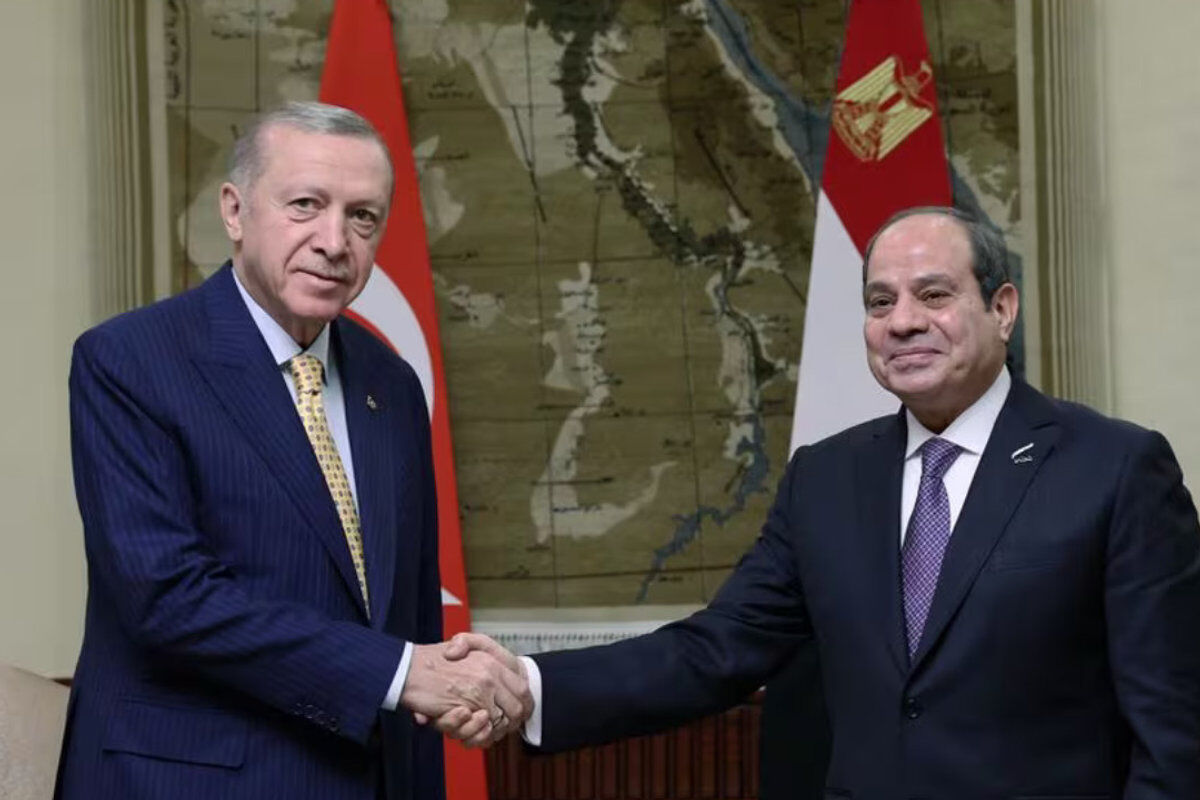
On 4 February 2026, Egyptian President Abdel Fattah el-Sisi received his Turkish counterpart, Recep Tayyip Erdoğan, in Cairo. The summit symbolised a profound transformation in a bilateral relationship long shaped by rivalry and strategic mistrust. The meeting showed that Ankara and Cairo had moved on from roughly a decade of indirect confrontation into a phase of openly embraced Realpolitik.
The visit was Erdoğan’s second to Cairo since the full restoration of diplomatic relations. The two leaders co-chaired the second meeting of the High-Level Strategic Cooperation Council and set out a clear objective: not to leave the relationship at the level of mere normalisation, but to turn it into a fully fledged strategic partnership. To symbolise this new momentum, President Erdoğan presented his Egyptian counterpart with a TOGG, Türkiye’s domestically produced electric car. The diplomatic gesture put Ankara’s technological and industrial ambitions in the spotlight.
The summit marked a decisive turning point, above all in the military field. The two governments concluded a framework agreement on military cooperation, signed by Egypt’s Defence Minister, General Abdel Meguid Saqr, and his Turkish counterpart, Yaşar Güler. The agreement sealed a remarkable upgrade in security cooperation between Ankara and Cairo. Türkiye’s defence industry signed an export contract worth a total of $350 million. The package included the sale of the short-range air defence system “Tolga”, valued at $130 million. The parties also planned a $220 million investment to set up production lines for 155 mm artillery ammunition in Egypt. The move strengthened Cairo’s strategic autonomy while at the same time creating a lasting military-industrial interdependence between the two countries. The talks also addressed joint drone production and Egypt’s interest in Türkiye’s stealth fighter jet project, KAAN. This was seen as a sign of an unprecedented level of strategic integration between the two countries.
In the economic sphere, the two presidents set an ambitious target: raising trade volume from $9 billion to $15 billion in the coming years. Egypt has become Türkiye’s largest trading partner in Africa. The visit aimed to remove administrative and logistical obstacles in order to accelerate mutual investment and ease the flow of trade. The tourism sector also recorded notable progress. In 2025, the number of Turkish tourists visiting Egypt rose by 43 per cent, a significant indicator that normalisation has now taken concrete hold.
Beyond the military and economic dimensions, the real foundation of this rapprochement lay in geopolitical convergence. On the Palestinian question, Abdel Fattah el-Sisi and Recep Tayyip Erdoğan displayed a common stance, opposing the forced displacement of Palestinians and calling for Israel’s complete withdrawal from the Gaza Strip. The two capitals coordinated their efforts to shore up the ceasefire and facilitate the delivery of humanitarian aid. While Egypt maintained its role as the central mediator, Türkiye brought its diplomatic weight on the international stage to bear. In the face of rising tensions, particularly those linked to the moves towards recognition of Somaliland backed by Israel, Ethiopia and the United Arab Emirates, Ankara and Cairo reaffirmed their support for the unity and territorial integrity of Somalia. This stance took concrete form as both countries reinforced their military presence in Mogadishu. Türkiye’s deployment of the landing ship TCG Sancaktar to the region was also viewed in this context. On the Sudan file, the two countries backed national institutions and argued that an inclusive political process should be launched once a humanitarian ceasefire is in place. Long a theatre of proxy wars, Libya is now seeing a consensus take shape around preserving sovereignty and unifying state institutions, including the military. The parties stressed that foreign interference must be rejected.
To understand the Cairo summit of February 2026, however, one must go back over the path that led to it. From the outbreak of the Arab Spring in 2011, Turkish-Egyptian relations passed through phases of rapprochement, rupture and indirect confrontation before finally evolving towards pragmatic cooperation. In 2011, Türkiye saw the popular uprisings in the region as a major strategic opportunity and promoted what came to be called the “Turkish model”, combining political Islam, electoral processes and a market economy. Recep Tayyip Erdoğan called for Hosni Mubarak to step down and positioned himself as a supporter of the Egyptian people’s democratic demands. During his visit to Cairo in September 2011 he was warmly received by part of the population. Mohamed Morsi’s election in 2012 further strengthened this momentum. Türkiye provided substantial political support to the Morsi government. Ahmet Davutoğlu, Türkiye’s foreign minister at the time, described the relationship as an “Axis of Democracy”.
The rupture came in July 2013, when Mohamed Morsi was removed from office by the army. Ankara described the event as a coup and sharply criticised the ousting of an elected president. Cairo, for its part, perceived Türkiye’s support for the Muslim Brotherhood as interference in its internal affairs. The diplomatic crisis led to the mutual expulsion of ambassadors and a prolonged deterioration in relations.
The rivalry then spilled over into regional theatres. In Libya, Türkiye backed the Tripoli government while Egypt supported Field Marshal Haftar. Türkiye’s intervention in 2019–2020 halted the advance of the forces backed by eastern Libya and further heightened tensions. In parallel, energy competition in the Eastern Mediterranean hardened. Egypt joined Greece, Cyprus and Israel in founding the East Mediterranean Gas Forum, from which Türkiye was excluded. Ankara responded by developing its “Blue Homeland” (Mavi Vatan) doctrine and contesting existing maritime boundary delimitations.
From 2021 onwards, a pragmatic shift began. Faced with economic and geopolitical difficulties, Türkiye turned towards a policy of regional normalisation. Egypt, for its part, sought to diversify its partnerships in the face of geopolitical challenges. The rapprochement began with quiet diplomacy conducted between intelligence services and technical officials.
The symbolically decisive moment came during the 2022 World Cup in Qatar. Through the mediation of Qatar’s Emir Tamim bin Hamad Al Thani, Abdel Fattah el-Sisi and Recep Tayyip Erdoğan shook hands in public during the opening ceremony. The gesture allowed an important psychological threshold to be crossed and accelerated the normalisation process. In 2023, diplomatic relations were fully restored. Erdoğan’s visit to Cairo in February 2024 consolidated the process and paved the way for the institutionalisation of the strategic partnership in 2026.
In sum, the meeting held in Cairo on 4 February 2026 did more than close the chapter on a “lost decade”; it laid the foundations of a new architecture of power in the Eastern Mediterranean. The creation of a durable institutional framework through the High-Level Strategic Cooperation Council shows that the relationship is intended to extend over the long term. Files such as Libya, Sudan and the Horn of Africa, once sources of tension, are gradually turning into areas of dialogue and coordination. Shaped by the logic of Realpolitik, this repositioning, together with the defence agreements and the ambitious $15 billion trade target, is creating an interdependence between the two countries that makes any return to hostility a costly and irrational option.
Beyond the bilateral dimension, this rapprochement should be seen as part of a broader reconfiguration of regional balances. In a Middle East marked by instability, the fragmentation of alliances and the multiplication of crises, Turkish-Egyptian cooperation is increasingly taking on a stabilising role. By coordinating their positions on files such as Gaza, the Red Sea and North African security, Ankara and Cairo are seeking to exert greater weight over the regional security architecture. While it does not erase every difference of view, the 2026 partnership reflects the will of both sides to manage their disagreements through political mechanisms rather than confrontation.
This article was first published in French on 17 February 2026 on Eurasiapeace. It was translated into Turkish by Eren Gökdemir.